Congratulations to Winston Yap on his PhD!
We are proud of Winston on his impressive PhD defence and work carried out in our group.
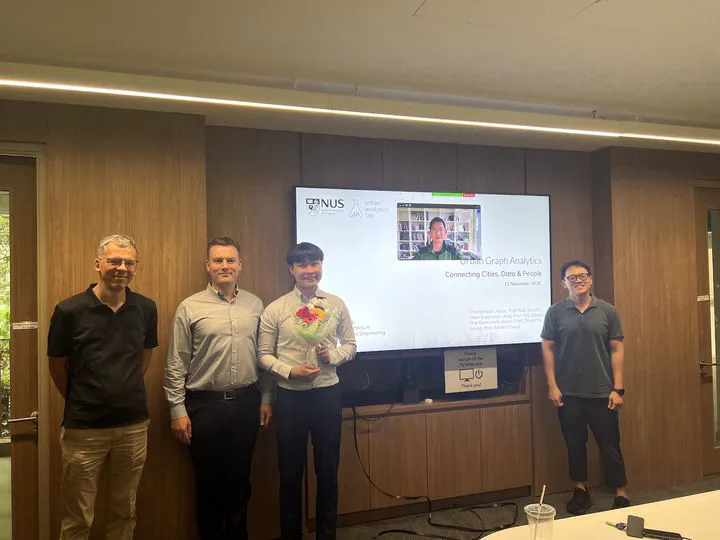 PhD defence of Winston Yap
On 11 November 2025, Winston Yap has defended his PhD thesis Urban Graph Analytics: Connecting Cities, Data, and People. Congratulations!
Winston has started his doctoral studies in 2021, following his graduation as Master of Urban Planning from NUS and research experience in academia.
During his PhD, he has advanced the application of urban graphs in urban analytics and demonstrated how can they serve as a powerful tool in urban planning. Winston’s work was published in leading journals, such as Nature Sustainability and Computers, Environment and Urban Systems. During his PhD, he has been invited to give talks at other institutions, and has conducted research visits at MIT and at a startup in Japan. Further, he was awarded the Singapore Data Science Consortium Dissertation Fellowship and was recognised as a World Cities Summit (WCS) Young Leader and participated in associated activities.
The committee members were Ye Zhang, Adrian Chong, Rudi Stouffs, and Filip Biljecki (thesis advisor).
We wish him all the best and lots of continued successes, and we thank him for the collaboration in the past years. Winston has substantially contributed to our research group and has been instrumental in shaping its research agenda. He will continue his career as a Postdoctoral Associate at Cornell University, earning the prestigious Ezra Systems Scholars fellowship.
To learn more about Winston’s work, visit his website and his Google Scholar profile.
Short abstract of his thesis:
Cities are under growing pressure to become both sustainable and equitable as they confront rapid urbanization and the slow-burn realities of climate change. Meeting these challenges increasingly depends on data-driven insights enabled by the explosion of large-scale geospatial data and advances in computational methods that reveal how cities grow, function, and evolve. Yet most computational efforts still develop in disciplinary silos, leaving them ill-equipped to address complex, interlocking issues such as housing, transportation, and climate resilience. To bridge this gap, this research introduces urban graph analytics, an extension of traditional street networks, that enables more integrated and interpretable, systems-based urban computational planning. Urban graphs offer a standardized, readily extensible framework for capturing the multiscale connections among people, infrastructure, and the urban environment. This research makes three primary contributions: 1) Conceptual development of urban graphs and their relevance for computational planning and design complex; 2) Implementation of open-source tools and datasets to make urban graph generation and analytics accessible and adaptable for any city worldwide; 3) Application of city graphs to real-world problems, such as advancing fair climate action across multiple cities and quantifying urban health outcomes. At its core, I hope to demonstrate how urban graphs can serve as a powerful tool for integrated, data-informed urban planning, helping cities achieve sustainability goals and improve quality of life for their residents.

Want to join us in your PhD journey? Read this guide.