Uncovering the Associations between Human Big Five Personality Traits and Built Environment Characteristics from Street View Imagery
Abstract
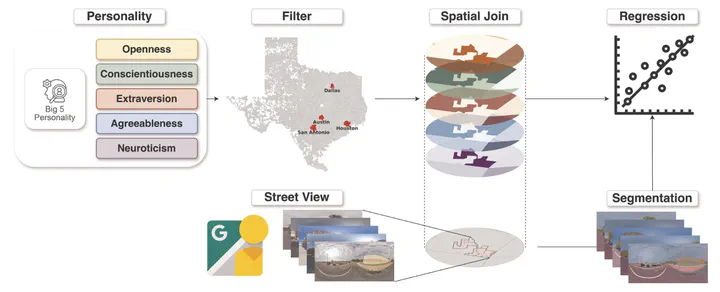
Human–environment interactions, a classic topic in geography, suggest that individuals and their environments might shape each other. Yet the specific mechanisms underlying these interactions regarding human personality traits have not been explored. This study examines the associations between human Big Five personality traits and built environment characteristics derived from street view imagery across four cities in Texas, United States, providing a descriptive foundation for understanding these complex human–environment dynamics. By integrating fine-resolution self-reported personality assessments with computer vision analysis of urban environments, we identified significant spatial clustering of personality traits at the ZIP code level. Our regression analyses reveal that built environment features and socioeconomic characteristics explain substantial variance in personality distributions, with Openness showing the strongest model fit (R2 = 0.47), followed by Agreeableness, Conscientiousness, Extraversion, and Neuroticism. Grouped built environment categories, socioeconomic factors, and demographic composition showed trait-specific patterns of association. These findings illustrate how personality traits could be associated with physical spaces at a smaller geographic scale than previously examined. Our results provide empirical evidence for understanding the link between psychological characteristics and environmental features, which can potentially enrich geography studies from a human-centered perspective.

Koichi Ito
PhD Researcher