Street space as health infrastructure: diagnosing uneven street support for exercise through the spatial triad
Abstract
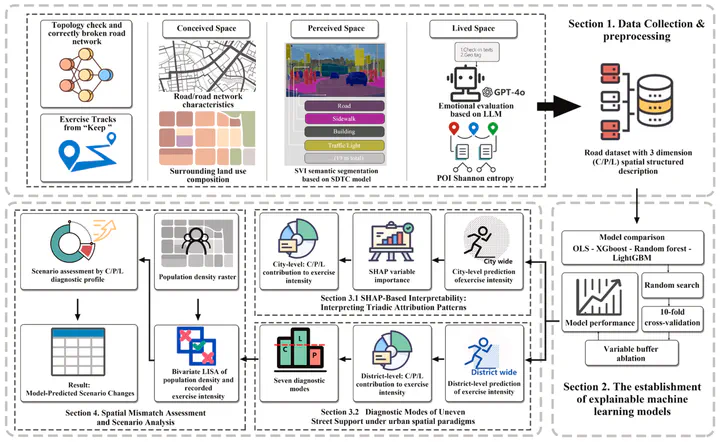
Urban streets constitute essential everyday health infrastructure within the outdoor built environment, yet their potential to support physical activity remains unevenly realized. Current assessments prioritize formal sports facilities or rely on coarse, area-level metrics, leaving street-level differences in exercise supportiveness less visible. To address this gap, this study develops a theory-informed analytical framework for examining modelled exercise-supportiveness deficits across street networks. We employ Henri Lefebvres spatial triad as an interpretive lens, conceptualizing urban space as a contradictory and co-productive unity of three interconnected dimensions: Conceived Space (representations of space), Perceived Space (spatial practice), and Lived Space (spaces of representation). Drawing on the research agenda of Critical Quantitative Geography, these dimensions provide a vocabulary for organizing evidence on planned form, visible street conditions, and everyday activity traces. SHAP is then used to examine how the resulting indicator groups are associated with exercise intensity. Using Shenzhen as a case study, the analysis shows that conceived-space indicators account for the largest share of grouped SHAP attribution, while perceived and lived indicators reveal important local low-supportiveness patterns across development contexts. Grouped SHAP attributions are then used to construct a seven-mode diagnostic typology that identifies which C/P/L readings are associated with lower modelled street-level exercise supportiveness. Furthermore, a bivariate spatial association analysis identifies clusters where high population density coincides with low recorded street-level exercise intensity, highlighting locations for closer planning assessment. The framework combines machine-learning attribution with spatial-theoretical interpretation to examine health-supportive everyday movement environments at the street-segment scale.

Filip Biljecki
Associate Professor