Exploring the links amongst place attachment, urban environment qualities, and psychological restoration: A case study of Hong Kong
Abstract
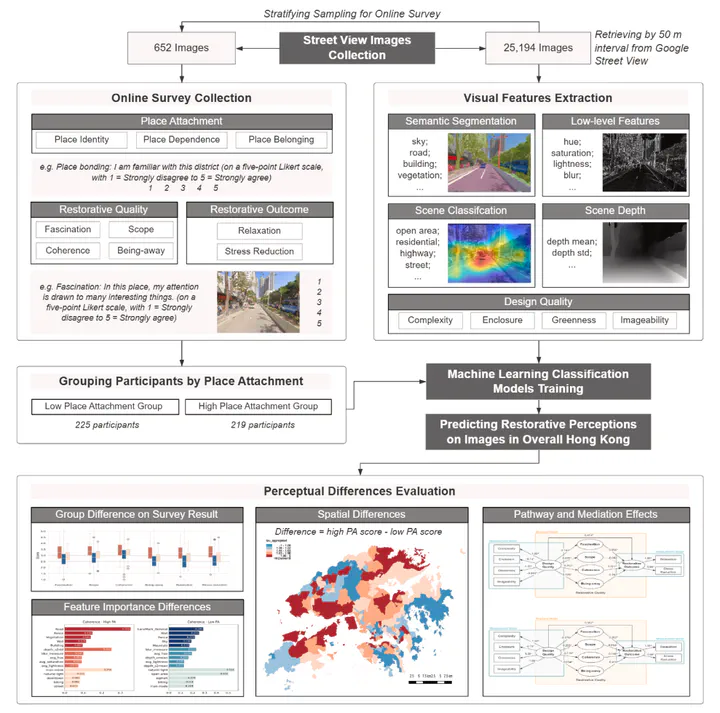
Urbanization often exacerbates psychological stress, partly due to a lack of psychological connection to urban spaces. While place attachment — the multidimensional bond between individuals and their surroundings — is known to benefit well-being, its specific influence on restorative perceptions at city or regional scale remains underexplored. This study introduces an innovative framework to investigate how place attachment levels affect restoration perception by analysing links between visual features, restorative qualities, and outcomes. Using street-level imagery, a survey (n = 547) was conducted in Hong Kong to gather restorative perceptions from residents with varied attachment levels. Machine learning models were then trained on this data and 25,194 street view images to map attachment variations at a regional scale. The research identifies key differences in restorative perceptions between populations with different place attachment levels, analysing survey-based variations, feature importance in machine learning, spatial disparities, and pathway relationships. The findings highlight the significant role of place attachment in contributing to restorative experiences, with high place attachment individuals showing stronger psychological recovery in urban environments. Moreover, spatial differences between high- and low-PA groups are greater in suburban areas. While high-attachment residents derive restoration from greenery, symbolic features, and high design qualities, low-attachment groups derive restoration from structural elements (e.g., roads and walls) that provide clear scope and spatial legibility. These insights offer perspectives on planning principles that foster a deeper connection to place. They propose tiered strategies tailored to the distinct needs of new developments versus historical districts, potentially supporting citizens’ long-term psychological well-being.

Sifan Cheng
Visiting Scholar
Xiucheng Liang
PhD Researcher