Vitality-oriented urban forms are associated with poorer indoor window views in Hong Kong
Abstract
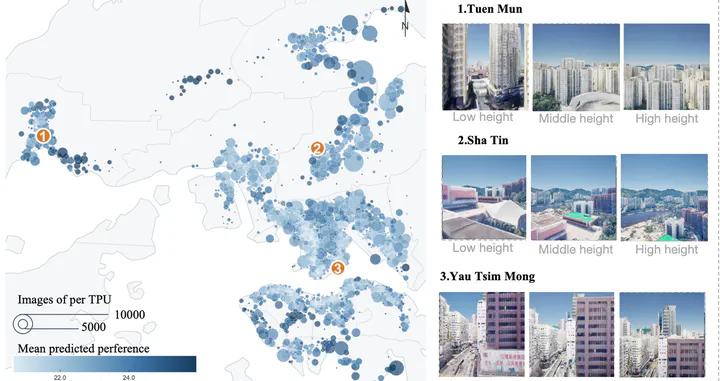
Some urban form characteristics, e.g., dense street network, diverse pedestrian destinations, can promote vitality, because they support walking, social interaction, and public life. Yet these characteristics mainly focus on pedestrians rather than indoor occupants, although people spend around 90% of their time indoors. Using 1,352,550 simulated window views across Hong Kong, this study examines whether vitality-oriented urban form indicators, including floor area ratio, road network density, point-of-interest entropy, and building-age entropy, are associated with model-predicted window-view quality. Multilevel mixed-effects models were used, complemented by height-interaction models (height refers to the vertical elevation), contextual heterogeneity tests, and multi-scale comparisons. The results show that road network density, point-of-interest entropy, and floor area ratio are negatively associated with window-view quality (β = − 0.111, − 0.082, and − 0.054, respectively; all p < 0.001), whereas the building-age association is very small (β = − 0.004). Moreover, window height is positively associated with window-view quality (β = 0.396), and all four height-interaction terms are positive (β = 0.026–0.055). Window-view quality was lowest in high-development-intensity Tertiary Planning Units, and associations with road network density and point-of-interest entropy were more negative in old urban areas. Across buffers, the road-density and floor area ratio associations remain negative in the predicted-score models. In the human-rated subsample, the height and two entropy associations remain directionally consistent, whereas the other two are sensitive to outcome measurement. The findings call for more vertically and contextually differentiated urban design strategies that consider indoor visual welfare alongside street-level vibrancy.