A graph neural network for small-area estimation: integrating spatial regularisation, heterogeneous spatial units, and Bayesian inference
Abstract
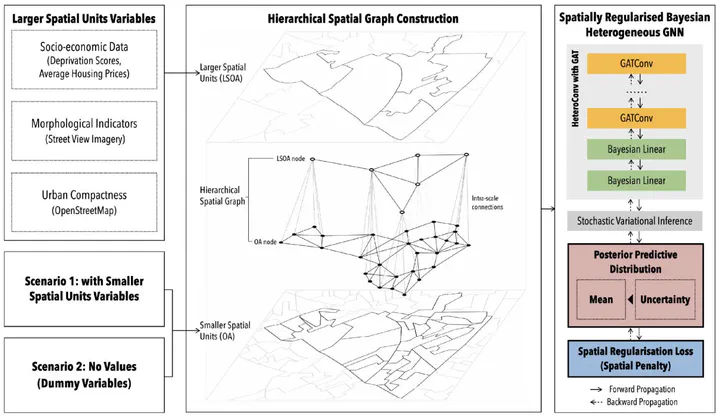
Fine-resolution spatial analytics are essential for urban planning and policy-making, yet traditional small-area estimation often struggles with sparse, hierarchical, or imbalanced data. This paper introduces a Spatially Regularised Bayesian Heterogeneous Graph Neural Network (SR-BHGNN) that integrates multiple census tract levels within a unified framework. The model builds a heterogeneous graph where nodes represent spatial units at different scales, edges encode adjacency or membership, and Bayesian inference quantifies uncertainty in parameters and predictions. A spatial regularisation term, inspired by Tobler’s First Law of Geography, penalises large discrepancies between neighbouring nodes, reducing errors in imbalanced datasets and ensuring coherent local estimates. We evaluate SR-BHGNN through two London case studies, population estimation and PM 2.5 prediction, comparing it against random forests, single-level GNNs, and spatial hierarchical Bayesian estimation. SR-BHGNN achieves strong performance gains, with classification accuracies of 0.85 for population estimation and 0.81 for PM 2.5 prediction. Its Bayesian design produces posterior distributions that capture uncertainty, enabling policy-relevant insights into vulnerable neighbourhoods or priority intervention zones (e.g. low-emission areas). These results demonstrate that SR-BHGNN advances the state of the art in small-area estimation, offering a flexible, uncertainty-aware framework for diverse urban analytics applications.

Pengyuan Liu
Research Fellow

Yang Chen
Visiting Scholar

Xiucheng Liang
PhD Researcher