BuildingMultiView: Powering multi-scale building characterization with large language models and Multi-perspective imagery
Abstract
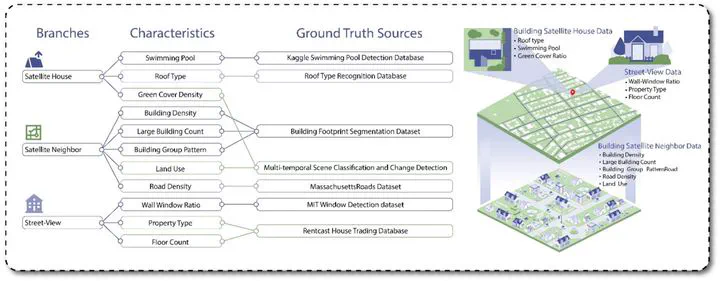
Buildings play a crucial role in shaping urban environments, influencing their physical, functional, and aesthetic characteristics. However, urban analytics is frequently limited by datasets lacking essential semantic details as well as fragmentation across diverse and incompatible data sources. To address these challenges, we conducted a comprehensive meta-analysis of 6,285 publications (2019–2024). From this review, we identified 11 key visually discernible building characteristics grouped into three branches: satellite house, satellite neighborhood, and street-view. Based on this structured characteristic system, we introduce BuildingMultiView, an innovative framework leveraging fine-tuned Large Language Models (LLMs) to systematically extract semantically detailed building characteristics from integrated satellite and street-view imagery. Using structured image–prompt–label triplets, the model efficiently annotates characteristics at multiple spatial scales. These characteristics include swimming pools, roof types, building density, wall–window ratio, and property types. Together, they provide a comprehensive and multi-perspective building database. Experiments conducted across five cities in the USA with diverse architecture and urban form, San Francisco, San Diego, Salt Lake City, Austin, and New York City, demonstrate significant performance improvements, with an F1 score of 79.77% compared to the untuned base version of ChatGPT’s 45.66%. These results reveal diverse urban building patterns and correlations between architectural and environmental characteristics, showcasing the framework’s capability to analyze both macro-scale and micro-scale urban building data. By integrating multi-perspective data sources with cutting-edge LLMs, BuildingMultiView enhances building data extraction, offering a scalable tool for urban planners to address sustainability, infrastructure, and human-centered design, enabling smarter, resilient cities.

Yunlei Su
Graduate Student