UAV-based built environment perception: Progress, challenges, prospects, and regulatory contexts
Abstract
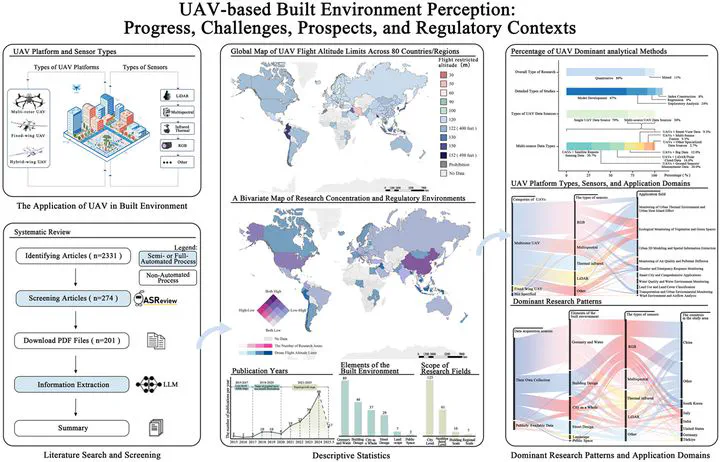
Uncrewed Aerial Vehicles (UAVs) have proven to be a transformative technology for the fine-scale perception of the built environment. The recent proliferation of new platforms, sensors, and algorithms creates unprecedented opportunities to understand a complex environment. However, effectively harnessing these opportunities requires a systematic assessment of the emerging methodological practices to address challenges concerning the comparability, reproducibility, and generalizability of the knowledge being produced. Therefore, this study aims to systematically map the dominant methodological workflows in UAV-based built environment perception and critically assess their implications for scientific knowledge production. We conducted a systematic review of 201 peer-reviewed articles in the last decade (2015–2025), complemented by the construction of a novel global dataset of UAV flight policies across 80 countries, to deconstruct the dominant research workflows and to synthesize the progress and challenges across key application domains. Our analysis, leveraging a novel method that integrates PRISMA, machine learning, and Large Language Models, reveals a pronounced convergence in research practices, which stands in contrast to the apparent diversity of available technologies. We determine that the state of the art is characterized by: (i) a geographical concentration of studies in the Global North, correlated with permissive regulatory environments; (ii) a technological path dependency on a ‘standardized toolkit’ of multirotor UAVs and RGB sensors; and (iii) a methodological reliance on self-collected data (91%) that often remains non-public, fostering a research ecosystem of quantitative, computer vision-based analysis. By diagnosing these dominant patterns and their associated challenges, we propose a forward-looking agenda centered on fostering open science, diversifying technologies, and expanding methodological horizons to build a more integrated, robust, and equitable research future.

Filip Biljecki
Associate Professor

Yan Zhang
Visiting Scholar
Pengyuan Liu
Research Fellow