Engaging undergraduates with urban planning and sustainable mobility: GenAI vs. human co-creation
Abstract
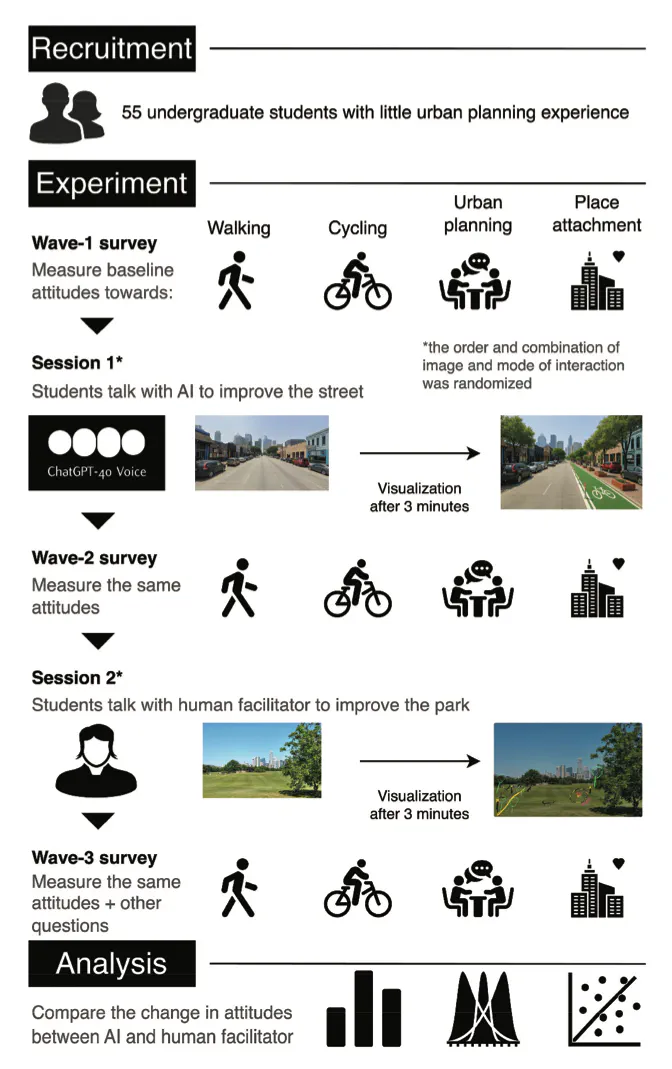
Brief, low-cost in-class activities can introduce undergraduates to urban planning and sustainable mobility, although few studies measure what one achieves. As generative AI (GenAI) enters planning practice, we compare two ways of delivering one: a conversational GenAI agent that generates imagery as it speaks, and a human facilitator working with sketches. Fifty-five undergraduates, none studying planning or architecture and most in their first two years, completed both in counterbalanced order, about three minutes each, rating four attitudes on 5-point scales before, between and after the sessions. The two modes moved different attitudes: among students who had met only their first method, support for cycling rose 0.63 of a point after the facilitator and 0.04 after the agent, and that advantage held once both sessions were counted. Willingness to participate in planning rose 0.39 after the agent and stayed flat after the facilitator, an exploratory result appearing at first contact only. A second, back-to-back session did not compound the first: willingness fell back whichever mode delivered it. Such an encounter triggers situational interest; it does not teach content. GenAI thus gives educators a low-cost way to stage that first encounter. The mode should therefore match the aim.

Koichi Ito
PhD Researcher