Trustworthy Transfer Learning in GeoAI: Assessing Pretrained Models for Rooftop Solar PV Mapping Under Geographic Domain Shift
Abstract
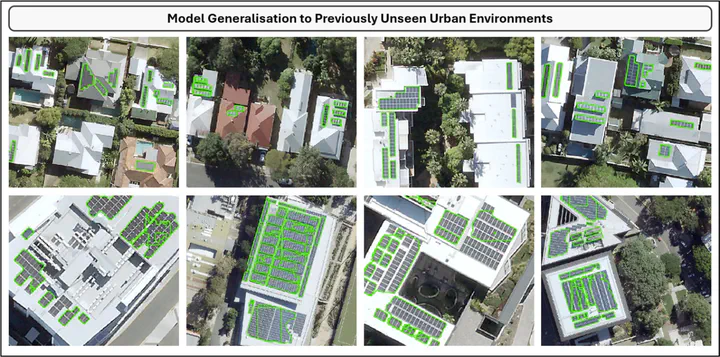
The increasing availability of pretrained Geospatial Artificial Intelligence (GeoAI) models has accelerated the operational adoption of deep learning within geographic information systems. However, models developed in one geographic region frequently experience performance degradation when deployed elsewhere because of geographic domain shift. Although transfer learning is widely used to improve cross-regional model performance, it remains unclear whether improved predictive accuracy alone provides sufficient evidence for trustworthy deployment. This study investigates this question using rooftop solar photovoltaic mapping in Brisbane, Australia, as an operational case study. Esri’s pretrained US Solar Panel Detection model was locally calibrated through transfer learning and evaluated using both development and independent local test datasets within Brisbane. Local calibration substantially improved detection performance, increasing recall from 38.5% to 84.1% on the development dataset, with similar improvements observed on the independent 10-grid test dataset, indicating effective local adaptation within the sampled Brisbane environments. However, independent evaluation and qualitative error analysis revealed persistent false positives, missed detections, and geometric segmentation errors, highlighting residual uncertainty and the limitations of model performance within the evaluated geographic context. These findings suggest that transfer learning can substantially improve detection performance and provide useful evidence for assessing operational trustworthiness, although predictive improvements alone are insufficient to establish trustworthy deployment. By integrating complementary evidence relating to robustness, reliability, generalisation, transparency, and residual uncertainty, this study provides an evidence-based operational approach for assessing pretrained GeoAI models and informing responsible deployment decisions in geographically distinct environments.