The restorative value of urban environments: A systematic review of quantitative evidence, methods and data
Abstract
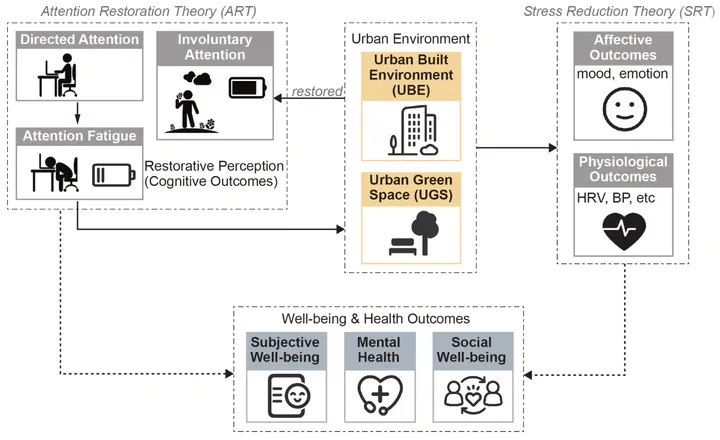
Amidst ongoing urbanisation, understanding how various urban elements contribute to stress reduction and well-being is increasingly crucial. However, existing research has prioritized natural elements, reinforcing a nature-urban dichotomy that overlooks the restorative potential of the built environment itself. This systematic review examines the restorative value of urban environments through quantitative studies from 2010 to 2024, exploring the effects on cognitive, affective, and physiological outcomes. Following the Synthesis Without Meta-analysis (SWiM) reporting guideline, it narratively synthesises findings from 50 quantitative human studies, identified through PRISMA-referenced screening of peer-reviewed articles that report associations between urban environmental characteristics and restorative outcomes. Results indicate urban spaces with integrated greenery are more often linked to higher perceived restorativeness and short-term psychological benefits than predominantly grey comparators. Several built environment characteristics, including architectural façade design, design quality, service facilities, and street-scale vegetation, were positively associated with restoration. Psycho-environmental characteristics (e.g., serenity, prospect, refuge) and person–place relationships further shape restorative experiences. Future research should focus more on various urban settings—high-density neighbourhoods, historical districts, and waterfronts—and compare similarities and differences in their restorative mechanisms. The review identifies emerging neuro-urbanism and big-data approaches as transformative tools; despite current methodological limitations, they radically expand the potential to clarify mechanisms and enhance generalisability. Based on the evidence extracted from the 50 studies, an evidence-informed, hypothesis-generating conceptual framework is proposed to map the observed associations between urban environment attributes, restorative value, and health and well-being. The framework organises current associational evidence and identifies testable pathways for future research rather than depicting confirmed causal chains.

Sifan Cheng
Visiting Scholar